
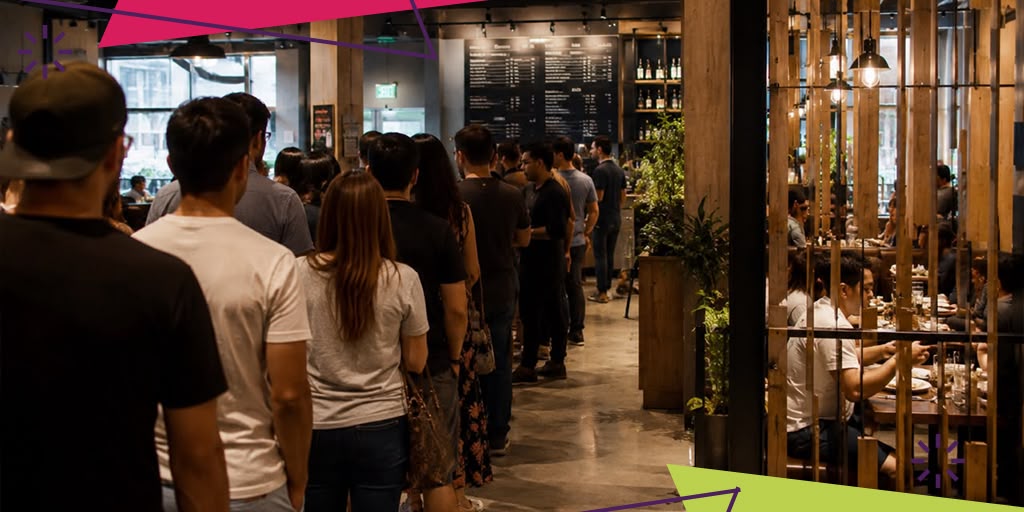
In the restaurant industry, the customer experience doesn’t begin when the food reaches the table. It starts the moment a customer discovers a restaurant, decides to visit, and walks through the door.
If they are met with a long, disorganized queue and have no idea how long they will have to wait, their perception of the restaurant can change immediately.
This is why restaurant queue management is becoming an increasingly important part of customer experience in 2027. As restaurants in Saudi Arabia continue adopting digital solutions, managing waiting times is no longer simply about taking names and calling customers when a table becomes available.
Modern restaurant queue management combines digital waitlists, reservations, table management, automated notifications, data analytics, and AI-powered forecasting to create a smoother experience for both customers and restaurant teams.
The goal isn’t simply to make customers wait fewer minutes. It is to make the entire waiting experience more predictable, convenient, and organized.
Why Do Restaurants Need Better Queue Management?
A restaurant may be busy because it is popular, but unmanaged crowds can quickly become an operational problem.
A customer who waits 30 minutes while knowing their estimated wait time may be more satisfied than someone who waits 15 minutes without knowing when they will be seated.
This is where a restaurant queue management system becomes valuable.
Instead of leaving customers and staff to manage the queue manually, the system can provide a clear view of:
- How many customers are waiting.
- How many tables are available.
- Which tables are suitable for each party.
- How long customers are likely to wait.
- Which reservations are coming up.
- When the restaurant is likely to reach peak capacity.
This creates a more organized experience while helping restaurants use their resources more efficiently.
From Traditional Queues to Digital Waitlists
In a traditional restaurant, customers arrive, give their names to a host, and wait near the entrance until someone calls them.
With a digital restaurant waitlist, the process can be much more efficient.
The restaurant can record information such as:
- Number of guests.
- Preferred table type.
- Arrival time.
- Customer contact details.
- Current wait status.
The system can then track table availability and determine which customer should be seated next.
This makes restaurant queue management more accurate and reduces the possibility of manual errors.
Virtual Queues Give Customers More Freedom
One of the biggest changes in modern restaurant waiting experiences is the use of a virtual queue.
Instead of standing outside the restaurant, customers can join the waitlist digitally and leave the immediate area.
If the estimated waiting time is 40 minutes, the customer could go shopping, sit in their car, visit a nearby location, or simply continue with their plans.
When their turn gets closer, they receive a notification such as:
“Your table will be ready in approximately 10 minutes.”
The customer is still waiting, but they are no longer trapped in a physical line.
This simple change can dramatically improve the perception of waiting time.
Accurate Wait-Time Estimates Matter
One of the biggest challenges in restaurant queue management is giving customers an accurate estimate.
If a restaurant tells a customer that the wait will be 20 minutes and the customer is still waiting 40 minutes later, the problem isn’t simply the long wait.
It is the loss of trust.
Modern restaurant waitlist systems can use real-time operational data to produce better estimates.
The system can consider:
- Current waiting customers.
- Available tables.
- Party sizes.
- Average dining duration.
- Upcoming reservations.
- Historical peak periods.
- Current restaurant capacity.
Instead of simply saying:
“Around 30 minutes.”
the system might provide:
“Estimated wait: 25–30 minutes.”
More accurate information allows customers to make better decisions.
How AI Can Improve Restaurant Queue Management
One of the most important developments in restaurant management in 2027 is the growing use of artificial intelligence.
AI can analyze historical restaurant data and identify patterns that may be difficult for managers to see manually.
For example, an AI-powered system might discover that:
- Thursday evenings consistently have higher demand.
- Customers spend longer at tables during weekends.
- Certain party sizes create longer seating times.
- Specific periods regularly create bottlenecks.
The system can use these insights to improve wait-time predictions and help restaurant managers prepare for busy periods.
This turns AI restaurant queue management from a simple waiting-list tool into a forecasting and decision-making system.
AI Can Predict Busy Periods Before They Happen
The real value of AI isn’t only knowing how many customers are waiting right now.
It is knowing when the queue is likely to become busy.
If historical data shows that demand increases sharply between 8 PM and 10 PM, the restaurant can prepare before the rush begins.
Management can:
- Increase staffing.
- Prepare tables earlier.
- Adjust reservations.
- Optimize table allocation.
- Prepare the kitchen.
- Organize front-of-house operations.
Instead of reacting to a queue after it forms, restaurants can start predicting and managing demand before it becomes a problem.
Table Management Is Just as Important as Queue Management
Sometimes the problem isn’t that a restaurant has too few tables.
The problem is that the available tables aren’t being used efficiently.
Imagine a restaurant has a table for two available while a party of two is waiting. At the same time, a large table is occupied by a smaller group.
Without intelligent table management, valuable capacity may be wasted.
A modern system can consider:
Party size + available tables + upcoming reservations + expected dining duration
to recommend the most appropriate table.
This can improve table turnover and help restaurants serve more customers without necessarily adding more physical space.
Not Every Customer Should Be Treated the Same
A party of two is different from a party of eight.
A customer requesting outdoor seating is different from someone who is happy with any available table.
A modern restaurant waitlist can consider factors such as:
- Party size.
- Table requirements.
- Seating preferences.
- Reservation schedules.
- Current table availability.
This allows restaurants to create a more flexible and intelligent waiting process instead of treating every customer exactly the same.
Connect Reservations With the Waitlist
Reservations and waitlists shouldn’t operate as completely separate systems.
Imagine a table for four becomes available at 8:30 PM but is reserved for another party at 9 PM.
If the waitlist system doesn’t know about the upcoming reservation, the table could be assigned incorrectly.
By connecting restaurant reservations, queue management, and table management, the restaurant gets a more complete view of its available capacity.
The system can determine not only which tables are available now, but which ones will remain available long enough to accommodate waiting customers.
Can Waiting Time Become a Sales Opportunity?
Waiting doesn’t necessarily mean that the customer cannot purchase anything.
If a customer is expected to be seated in 15 minutes, the restaurant could offer optional drinks, appetizers, or other items that can be prepared in advance.
For example:
“Your table will be ready soon. Would you like to start with drinks or appetizers?”
This can turn part of the waiting period into an opportunity to increase the customer’s order value.
However, this should always be optional and relevant. The goal is to improve the experience, not make customers feel pressured to spend more while waiting.
Pre-Ordering Can Reduce Service Time
Some restaurants can connect their digital waitlist with online ordering.
While customers are waiting, they can browse the menu and begin selecting what they want.
By the time they reach their table, part of the ordering process may already be complete.
This can be particularly useful during peak periods because it reduces the time between seating and order placement.
What Happens When Customers Leave the Queue?
One of the most important metrics for restaurant operators is queue abandonment.
This refers to customers who join the waitlist but leave before being seated.
If this number is consistently high, it may indicate problems with:
- Waiting times.
- Wait-time accuracy.
- Customer communication.
- Table availability.
- Reservation management.
- Staffing.
- Restaurant capacity.
That’s why restaurants shouldn’t only ask:
“How many people waited?”
They should also ask:
“How many people left before being seated, and why?”
This data can reveal problems that aren’t obvious from the size of the queue alone.
Use Queue Data to Find Operational Bottlenecks
Every waiting customer can provide useful information about restaurant operations.
If customers are waiting because tables aren’t being cleaned quickly enough, the problem isn’t necessarily the number of tables.
If the kitchen is causing delays, adding more tables won’t solve the problem.
If there aren’t enough employees during peak periods, the solution may be better staff scheduling.
This is why restaurant queue data should be used to identify the actual bottleneck, rather than simply measuring how long the queue is.
Managing Restaurant Queues During Ramadan and Seasonal Peaks
Restaurants in Saudi Arabia face significant changes in customer behavior during certain periods.
These can include:
- Ramadan.
- Eid Al-Fitr.
- Eid Al-Adha.
- School holidays.
- Public holidays.
- Major events.
- Seasonal campaigns.
During these periods, peak dining hours can change significantly.
For example, a restaurant may have relatively low demand at certain times during normal weeks but experience extremely high demand during specific Ramadan or Eid periods.
This means restaurants shouldn’t rely only on annual averages.
Historical seasonal data can help create better forecasts and improve queue management during future peak periods.
Managing Queues Across Multiple Restaurant Locations
For restaurant groups and chains, queue management data can become an important tool for comparing branch performance.
Management can compare locations based on:
- Average waiting time.
- Queue abandonment.
- Table turnover.
- Peak hours.
- Number of reservations.
- Customer volume.
- Staff performance.
If one location consistently manages queues more efficiently, management can identify what that branch is doing differently and apply successful practices across other locations.
The Most Important Restaurant Queue Metrics
Successful queue management should be measured using data rather than assumptions.
Important metrics include:
Average Wait Time
How long does a customer typically wait?
Maximum Wait Time
What is the longest waiting experience during the day?
Table Turnover Rate
How efficiently are tables being reused?
Queue Abandonment Rate
How many customers leave before being seated?
Average Dining Duration
How long do customers typically stay at their tables?
Customer Satisfaction
How do customers rate the waiting experience?
Tracking these metrics gives restaurant managers a clearer picture of where improvements are needed.
How to Choose a Restaurant Queue Management System
When choosing a restaurant queue management system, don’t focus only on whether it can record customer names.
Look for a solution that can work as part of the restaurant’s wider operational ecosystem.
Useful capabilities may include:
- Digital waitlists.
- Virtual queues.
- Table management.
- Reservations.
- Automated notifications.
- Reporting and analytics.
- POS integration.
- Multi-location management.
- Customer data.
- Demand forecasting.
- AI-powered insights.
The system should also be easy for employees to use and simple enough for customers to understand.
Technology should reduce operational complexity, not create more of it.
What Will Restaurant Queue Management Look Like in 2027?
The traditional customer journey looks like this:
Arrive → Stand in line → Wait → Get seated
The modern journey can become:
Book or join the waitlist → Receive an estimated time → Track your position → Receive a notification → Get assigned a table → Start ordering → Get seated
This means queue management will no longer be an isolated tool.
It will become part of a broader restaurant technology ecosystem connecting:
Reservations + Table Management + POS + CRM + Analytics + AI
The restaurant can then manage the entire customer journey rather than simply managing the queue at the entrance.
How Can Restaurants Improve the Waiting Experience?
There isn’t one solution that works for every restaurant.
Start by identifying why customers are waiting.
If the problem is a lack of information, introduce a digital waitlist.
If customers are leaving because they don’t want to stand around, introduce a virtual queue.
If tables aren’t being used efficiently, improve table management.
If queues appear suddenly during peak periods, use demand forecasting.
If customers are waiting too long after being seated, look at ordering and kitchen processes.
The best queue management strategy addresses the underlying operational problem rather than simply hiding the queue.
The Role of Local SEO and Customer Experience
Restaurant queue management can also indirectly support a restaurant’s broader digital presence.
A smoother customer experience can contribute to better customer satisfaction, which can encourage more genuine reviews and repeat visits.
For restaurants competing for searches such as “restaurants near me,” “best restaurants in Riyadh,” “family restaurants in Jeddah,” or other local searches, customer experience is part of the overall brand reputation.
Google Maps visibility and restaurant SEO shouldn’t be treated separately from operations.
A restaurant may attract a customer through Google Search, convince them through great photos and reviews, and then lose them because of a poorly managed waiting experience.
The strongest restaurant strategies connect digital discovery with real-world customer experience.
The Future of Restaurant Queue Management
The future isn’t necessarily about eliminating queues completely.
It’s about making them smarter, more predictable, and less frustrating.
A customer shouldn’t have to wonder:
“How much longer do I have to wait?”
Instead, the restaurant should be able to provide a clear answer.
With digital waitlists, virtual queues, table management, automated communication, analytics, and AI-powered forecasting, restaurants can move from simply reacting to crowded dining rooms to predicting demand and managing capacity proactively.
Conclusion
In 2027, restaurant queue management will be much more than organizing customers at the entrance.
It will become an important part of restaurant operations, customer experience, and revenue management.
A long queue isn’t necessarily a bad thing. A restaurant may have a queue because customers genuinely want to eat there.
The real problem is unpredictable and poorly managed waiting.
When customers know their estimated wait time, can leave the physical queue, receive timely notifications, and get seated efficiently, even a busy restaurant can provide a positive experience.
For restaurants in Saudi Arabia, combining digital waitlists, reservations, table management, customer notifications, data analytics, and artificial intelligence can create a more efficient operation while giving customers something increasingly valuable:
control over their time.
And ultimately, the best restaurant queue management system isn’t the one that simply makes customers wait less.
It’s the one that makes customers feel that their time matters.