
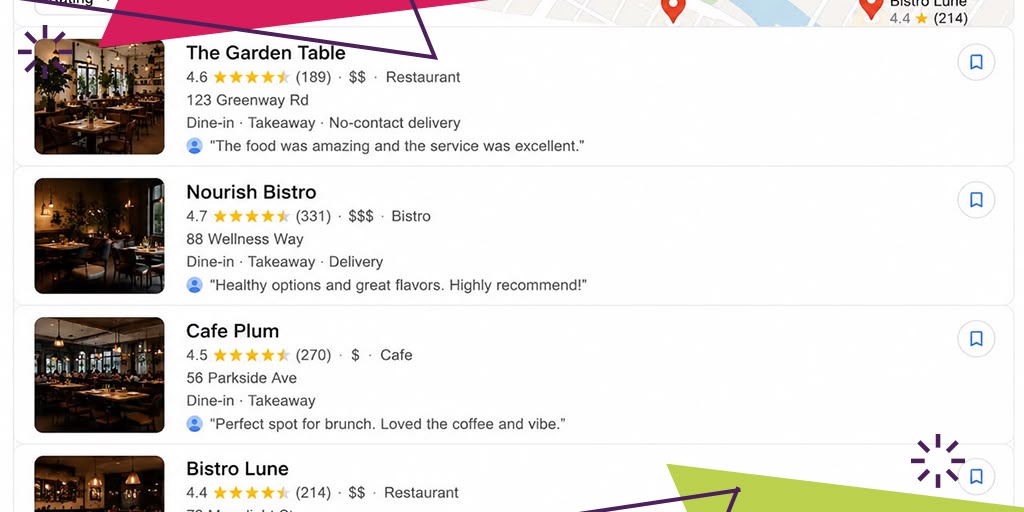
If you own a restaurant in Saudi Arabia, appearing on Google Maps is no longer optional. It has become an essential part of restaurant digital marketing and local SEO.
When customers search for terms such as “restaurants near me,” “best restaurants in Riyadh,” “burger restaurants in Jeddah,” or “family restaurants near me,” Google can show local businesses through Google Search and Google Maps.
For restaurants, this creates a major opportunity: reach customers at the exact moment they are looking for somewhere to eat.
Google explains that local search results are primarily influenced by relevance, distance, and prominence, while complete and accurate business information helps Google understand which businesses are relevant to a particular search.
As we move into 2027, restaurant owners should think beyond simply creating a Google Business Profile. A strong strategy combines Google Maps SEO, Local SEO, Restaurant SEO, reviews, content marketing, and GEO (Generative Engine Optimization).
Here is how to improve your restaurant’s visibility on Google Maps in Saudi Arabia.
1. Create a Google Business Profile for Your Restaurant
The first step is to create or claim your restaurant’s Google Business Profile.
Once verified, your profile can appear across Google Search and Google Maps, and you can manage the information customers see about your restaurant.
Your profile should include:
- Restaurant name.
- Accurate address.
- Phone number.
- Opening hours.
- Location on Google Maps.
- Primary business category.
- Relevant additional categories.
- Menu.
- High-quality photos.
- Website.
- Reservation information, if applicable.
- Ordering and delivery options.
For restaurants in Saudi Arabia, keeping this information accurate is particularly important because customers often use Google Maps to decide where to eat, navigate to the restaurant, or call before visiting.
2. Use Your Real Restaurant Name
One common mistake is trying to add keywords to the restaurant name.
For example, if your actual brand name is:
Burger House
don’t change the Google Business Profile name to:
Burger House – Best Burger Restaurant in Riyadh
unless that is genuinely how the business is represented in the real world.
Google’s guidelines require businesses to represent their names as they are used in the real world.
Instead of keyword stuffing your name, use relevant keywords naturally throughout:
- Your website.
- Business description.
- Menu.
- Local content.
- Restaurant pages.
- Reviews generated naturally by customers.
3. Choose the Right Restaurant Category
Your primary business category is an important part of your Google Business Profile.
Choose the category that best represents your restaurant’s main business.
For example, depending on what you actually offer, this could relate to:
- Restaurant.
- Italian restaurant.
- Burger restaurant.
- Seafood restaurant.
- Cafe.
- Fast food restaurant.
Google recommends choosing the fewest categories necessary to describe the core business accurately rather than adding a large number of unrelated categories.
The goal isn’t to select every category you can find.
The goal is to tell Google exactly what your restaurant is.
4. Complete Every Important Section
Don’t leave your restaurant profile half empty.
Google recommends providing complete and detailed business information because this helps Google understand the relevance of the business to local searches.
Make sure your profile includes:
Business name
Address
Phone number
Opening hours
Website
Menu
Restaurant category
Photos
Ordering information
Reservation information
Delivery options
Review these details regularly, especially during:
- Ramadan.
- Eid.
- Public holidays.
- Seasonal periods.
- Special events.
- Changes in opening hours.
5. Make Sure Your Restaurant Location Is Accurate
Your Google Maps location should point to your restaurant’s actual physical location.
This is especially important for restaurants because customers may use Google Maps navigation to physically reach the location.
Google’s guidelines emphasize that businesses should provide accurate location and address information.
An incorrect map pin can create a frustrating customer experience even if your restaurant ranks well.
6. Add Your Menu to Google
Your restaurant menu isn’t just useful for customers.
It also provides important information about what your restaurant actually offers.
Your menu can include:
- Main dishes.
- Appetizers.
- Burgers.
- Pizza.
- Seafood.
- Breakfast.
- Desserts.
- Drinks.
- Vegetarian options.
- Special dishes.
Google provides restaurants with specific menu features for displaying food and beverage offerings.
Keep the menu updated.
If you remove a dish, update it.
If you launch a new dish, add it.
If prices or ingredients change, update the information where appropriate.
7. Add High-Quality Restaurant Photos
Photos can have a major influence on whether someone chooses to visit your restaurant.
Imagine someone searching for:
“Burger restaurants in Riyadh.”
They see two restaurants.
Restaurant A has:
- High-quality food photography.
- Interior photos.
- Exterior photos.
- Seating photos.
- Menu photos.
- Product photos.
Restaurant B has one old, blurry photo.
The first restaurant immediately provides more information and creates a stronger first impression.
Consider adding:
Food Photography
Show your signature dishes and best sellers.
Interior Photography
Show the restaurant atmosphere and seating.
Exterior Photography
Help customers recognize the restaurant when they arrive.
Detail Photography
Show:
- Packaging.
- Drinks.
- Desserts.
- New dishes.
- Special menu items.
Branch Photography
If you have multiple locations, make sure customers can understand each branch.
8. Encourage Genuine Google Reviews
Reviews are an important part of a restaurant’s local presence.
Google states that prominence can be influenced by factors such as the number of websites linking to a business and the number of reviews it receives. Positive reviews can also help local ranking.
However, there is an important difference between:
Encouraging genuine customers to leave reviews
and:
Buying or manipulating reviews.
A restaurant can simply make asking for feedback part of the customer journey.
For example:
“How was your experience? We’d love to hear your feedback on Google.”
If the experience was positive, the customer may naturally choose to leave a review.
9. Don’t Buy Google Reviews
Buying dozens of reviews may look like a quick shortcut, but it is not a sustainable restaurant marketing strategy.
Instead, focus on:
Real customers + real experiences + genuine reviews.
The objective isn’t simply to achieve a high rating.
It is to build real trust with customers who are comparing restaurants before deciding where to eat.
10. Optimize Your Restaurant Website for Local SEO
Your Google Business Profile is only one part of your local search strategy.
Your website should also be optimized for Restaurant Local SEO.
Your main restaurant page should clearly communicate:
Restaurant name
Cuisine type
City
Location
Branches
Phone number
Opening hours
Menu
Ordering options
Reservation options
If you operate multiple branches, create a useful page for each location.
For example:
Restaurant XYZ – Riyadh
Restaurant XYZ – Jeddah
Restaurant XYZ – Khobar
But don’t simply duplicate the same page and replace the city name.
Each branch page should contain genuinely useful information about that specific location.
11. Target Local Search Intent
Don’t focus exclusively on the broad keyword:
“Restaurant.”
Think about how customers actually search.
Examples include:
- Restaurants in Riyadh.
- Restaurants in Jeddah.
- Restaurants near me.
- Best burger restaurants in Riyadh.
- Family restaurants in Riyadh.
- Breakfast restaurants in Jeddah.
- Italian restaurants in Riyadh.
- Sushi restaurants in Jeddah.
- Restaurants open now.
- Restaurants for dinner.
- Restaurants near Al Olaya.
- Family-friendly restaurants near me.
These represent different types of search intent.
Your goal is to make your restaurant relevant when the search genuinely matches what you offer.
12. Create Local Content Around Your Restaurant
If you want to improve Restaurant SEO in Saudi Arabia, don’t rely only on your restaurant’s homepage.
Create useful local content around your cuisine, location, customers, and services.
For example, a restaurant in Riyadh could create content such as:
Best Burger Restaurants in North Riyadh
Best Places for Dinner in Riyadh
Best Family Restaurants in Riyadh
Restaurants Near Al Olaya
Best Breakfast Restaurants in Riyadh
However, the content should genuinely help users rather than simply repeating keywords.
13. Build Consistent Local Citations
Google can use multiple signals to understand a local business.
That’s why your restaurant’s information should be consistent across the web.
Consider your presence across:
- Restaurant website.
- Social media profiles.
- Business directories.
- Local websites.
- Food publications.
- Event websites.
- Relevant restaurant platforms.
Keep key information consistent:
Restaurant name + address + phone number + website.
Google’s business guidelines emphasize representing a business accurately and consistently.
14. Understand the Importance of Distance
One important factor in Google Maps is:
Distance.
This means the distance between the person searching and the restaurant.
Google identifies distance as one of the primary factors in local search rankings, alongside relevance and prominence.
This means you can’t make a restaurant in Jeddah appear as though it is located in Riyadh simply by adding the word “Riyadh” to your website.
The restaurant’s real location matters.
This is why Local SEO is a long-term strategy, not simply a keyword exercise.
15. Build Restaurant Prominence Beyond Google Maps
Another important concept is:
Prominence.
A restaurant can build stronger digital visibility through:
- Genuine reviews.
- Links from relevant websites.
- Local media coverage.
- Restaurant publications.
- Social media presence.
- Brand searches.
- Local content.
- Mentions from reputable websites.
Google explains that prominence can be influenced by information such as the number of websites linking to a business and the number of reviews it receives.
So don’t treat Google Maps as an isolated marketing channel.
Connect it with your entire restaurant marketing strategy.
16. Use Social Media to Strengthen Local Visibility
If you launch a new dish, don’t simply post it on Instagram.
Connect the campaign to a specific location when relevant.
For example:
“Our new burger is now available at our North Riyadh branch.”
Or:
“Now available at our Jeddah – Al Rawdah location.”
You can use:
- Instagram.
- TikTok.
- Snapchat.
- YouTube.
to build stronger local awareness around your restaurant and individual branches.
17. Combine Google Maps SEO With GEO
In 2027, restaurant visibility won’t be limited to traditional Google Search results.
As AI-powered search and recommendation systems become more common, restaurants should make their information easy for AI systems to understand.
This is where:
GEO — Generative Engine Optimization
becomes increasingly relevant.
Your restaurant’s online presence should clearly communicate:
- Cuisine type.
- Location.
- City.
- Neighborhood.
- Price range.
- Opening hours.
- Popular dishes.
- Restaurant services.
- Seating options.
- Delivery.
- Reservations.
Instead of simply saying:
“We are the best restaurant in Riyadh.”
provide specific information such as:
“A burger restaurant in North Riyadh serving fresh beef burgers with dine-in and delivery options.”
Specific information is more useful for matching your restaurant with relevant search contexts.
18. Keep Your Google Business Profile Updated
One of the most common mistakes is creating a Google Business Profile and then forgetting about it.
Restaurants change constantly.
Regularly review:
- Opening hours.
- Ramadan hours.
- Holiday hours.
- Menu.
- Photos.
- Phone numbers.
- Location.
- Services.
- Branches.
- Website and ordering links.
When your restaurant changes, your digital presence should change too.
The Main Google Maps Ranking Factors for Restaurants in 2027
A restaurant’s local visibility can be viewed through four key areas:
1. Relevance
Does your restaurant match what the customer is searching for?
2. Distance
How close is the restaurant to the person searching?
3. Prominence
How established and well-known is the restaurant online?
4. Information Accuracy
Is the restaurant’s information complete, accurate, and consistent?
Google identifies relevance, distance, and prominence as the main factors for local results, while complete and accurate business information helps Google understand the business.
Common Mistakes That Can Hurt Restaurant Visibility on Google Maps
Avoid these mistakes:
❌ Keyword-stuffing your restaurant name
Use your actual brand name.
❌ Creating multiple profiles for the same location
Google’s guidelines indicate that multiple profiles for the same business/location can create problems.
❌ Using a fake address
Use the restaurant’s actual location.
❌ Choosing irrelevant categories
Choose categories that accurately describe the business.
❌ Buying reviews
Build genuine customer feedback.
❌ Ignoring photos
Visual information matters to customers.
❌ Leaving outdated opening hours
This is particularly important during Ramadan, Eid, holidays, and seasonal periods.
❌ Creating duplicate SEO pages
Every local page should provide genuine value.
A Practical Google Maps Strategy for Saudi Restaurants in 2027
You can organize your strategy into four stages.
Stage 1: Build the Foundation
- Create a Google Business Profile.
- Claim an existing profile if necessary.
- Verify the restaurant.
- Add the correct address.
- Choose the appropriate category.
- Add your phone number.
- Add opening hours.
- Add your menu.
- Add your website.
Stage 2: Optimize the Profile
- Add professional photos.
- Keep the menu updated.
- Add relevant products or dishes where available.
- Update services.
- Add appropriate links.
- Monitor customer questions.
- Respond to reviews.
Stage 3: Build Local SEO
- Create branch pages.
- Optimize your restaurant website.
- Publish local content.
- Build relevant local links and mentions.
- Keep your business information consistent.
Stage 4: Prepare for GEO and AI Search
- Answer customer questions through useful content.
- Clearly explain your restaurant’s specialty.
- Clearly identify locations and branches.
- Provide accurate information about dishes and services.
- Build a trustworthy and consistent digital presence.
Can You Guarantee the #1 Position on Google Maps?
No.
There is no legitimate way to pay Google or request a better local ranking. Google explicitly states that there is no way to request or pay for a better local ranking.
So be careful with companies promising:
“We’ll guarantee your restaurant the #1 position on Google Maps.”
A sustainable strategy is based on:
Complete profile + accurate information + real location + genuine reviews + useful local content + strong website + trustworthy online presence.
Conclusion
If you want your restaurant to appear on Google Maps in Saudi Arabia in 2027, don’t think of Google Maps as simply a pin on a map.
It is part of a much larger ecosystem:
Google Maps + Google Search + Local SEO + Restaurant SEO + Reviews + Website + Social Media + GEO
Start by creating and verifying your Google Business Profile, then make sure your restaurant name, location, category, opening hours, menu, and contact information are accurate and up to date.
Then focus on building genuine customer trust through excellent experiences and authentic reviews, while creating useful local content that helps both Google and customers understand where your restaurant is, what it offers, and why it is relevant to them.
Most importantly, don’t try to manipulate Google with keyword stuffing, fake addresses, or purchased reviews.
Make your restaurant clear to Google, useful to customers, and strong in its local market.
That’s the foundation for being discovered when someone searches for a restaurant nearby, the best restaurant in a specific area, or a particular type of cuisine in Saudi Arabia.